Back to Industry News
What are the international standards for flanges?
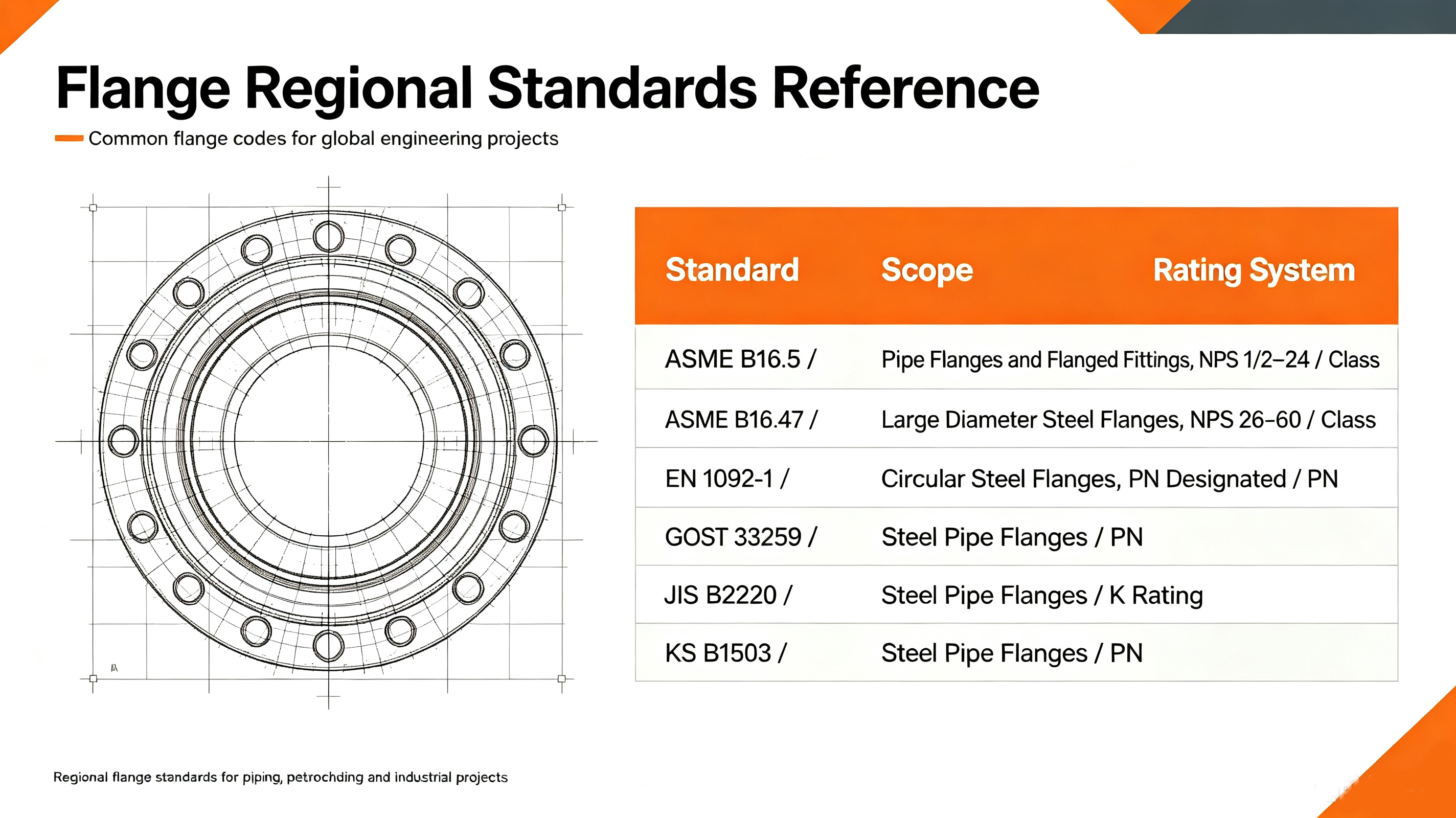
Flange standards vary by region and application. Understanding the key international standards is essential for specifying the correct flanges for your project.
Major International Flange Standards
- ASME B16.5 — Pipe Flanges and Flanged Fittings, NPS 1/2–24, Class rated (Class 150 to 2500). The dominant standard in North America and widely adopted globally.
- ASME B16.47 — Large Diameter Steel Flanges, NPS 26–60, Class rated. Covers Series A (MSS SP-44) and Series B (API 605).
- EN 1092-1 — Circular Steel Flanges for Pipes and Valves, PN designated (PN 6 to PN 400). The primary European standard.
- GB/T 9112–9124 — Chinese national standards for steel pipe flanges, PN and Class rated. Widely used in domestic and international projects sourced from China.
- HG/T 20592–20635 — Chinese chemical industry standards for steel pipe flanges, covering PN and Class series with detailed material and dimension requirements.
- JIS B2220 — Japanese Industrial Standard for steel pipe flanges, K rated (5K to 63K). Common in Japanese engineering projects.
- GOST 33259 — Russian/EAEU standard for steel pipe flanges, PN designated. Required for projects in Russia and CIS countries.
- ISO 7005 — International standard that harmonizes EN and ASME flange dimensions for global interoperability.
- BS 4504 — British Standard for circular steel flanges, largely superseded by EN 1092-1 but still referenced in legacy specifications.
- MSS SP-44 — Steel Pipeline Flanges, large diameter, Class rated. Incorporated as Series A in ASME B16.47.
- API 605 — Large Diameter Carbon Steel Flanges, Class rated. Incorporated as Series B in ASME B16.47.
Class vs PN Rating Systems
The Class system (ASME) and PN system (EN/ISO) are two different pressure rating methodologies. They cannot be directly interchanged:
- Class ratings are based on maximum allowable pressure at specific temperatures (e.g., Class 150 at 100°F).
- PN ratings indicate nominal pressure in bar at 20°C (e.g., PN 16 = 16 bar at 20°C).
- While approximate equivalences exist (e.g., Class 150 ≈ PN 20, Class 300 ≈ PN 50), the actual pressure-temperature ratings differ significantly.
- Always refer to the specific standard's pressure-temperature rating tables for accurate selection.
When specifying flanges for international projects, always confirm the applicable standard with the project engineer and verify compatibility between connected components.