What are the machining processes for flanges?
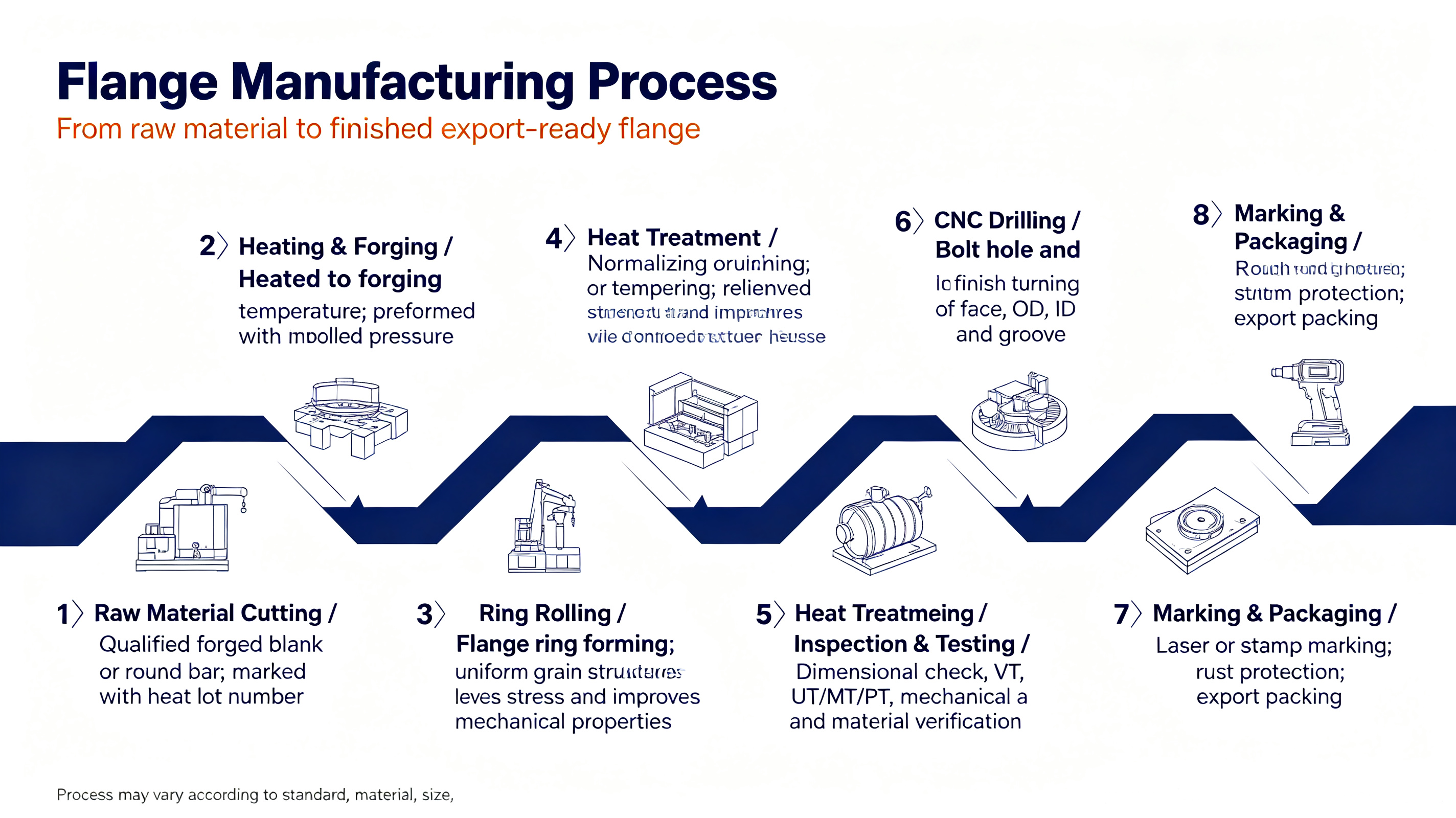
The complete manufacturing process from raw material to finished export-ready flange involves 12 key steps:
Raw Material Cutting
Use qualified forged blanks/round steel from steel mills. Cut materials according to drawing dimensions. Material certificates are supplied, and heat lot numbers are marked.
Material Transfer
Deliver the cut blanks to the heating furnace station.
Scale Removal
Remove surface scale before blank heating or after preliminary forging to prevent defects from being pressed into the workpiece.
Heating & Forging
Heat blanks to the forging temperature range. Preform by pressing with hydraulic press. Control pressure and temperature to guarantee mechanical properties.
Ring Rolling
Special process for flange rings. Form by ring rolling to achieve uniform grain structure on cross-section and improve strength.
Sizing
Correct flange face and outer diameter to eliminate forging deformation.
Heat Treatment (on demand)
Normalizing/tempering to refine grains and relieve internal forging stress to meet mechanical property requirements (mandatory for certain standards).
CNC Rough Machining
Rough-turn flange face, inner & outer diameter on CNC lathe; leave machining allowance for sealing face.
CNC Finishing
Finish-turn sealing face, thickness and bevel to ensure dimensional accuracy and flatness.
High-Speed CNC Drilling
Machine bolt holes and guarantee indexing accuracy of hole positions.
Inspection & Testing
Dimensional measurement, visual inspection, NDT (UT/MT/PT as required), mechanical tests, and batch traceability verification against material test reports.
Marking & Packaging
Laser/steel stamping marking (heat number, material grade, standard, specification). Rust removal and anti-corrosion protection, professional packaging suitable for export sea freight.