What are the types of flange sealing faces?
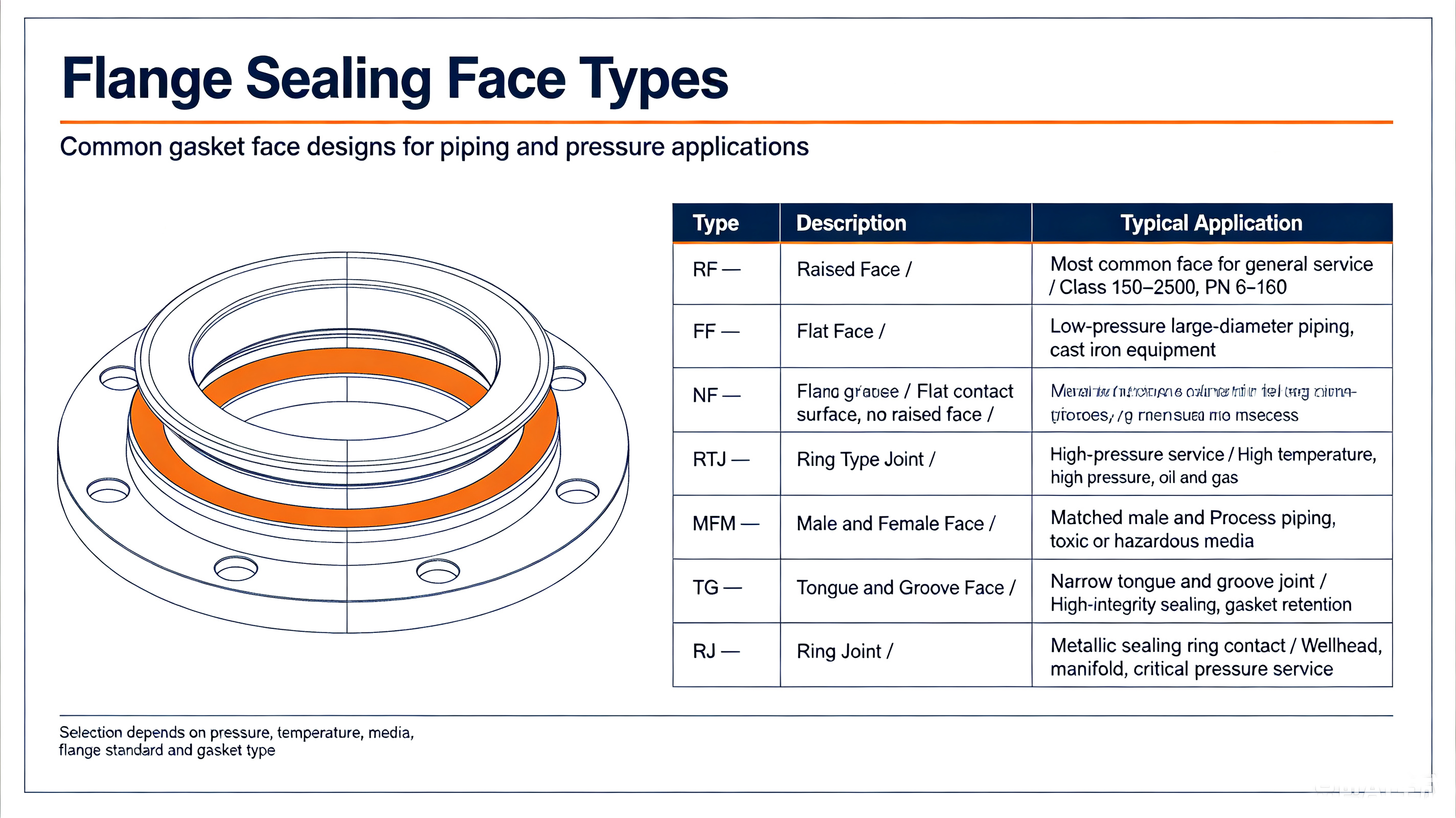
The sealing face (or gasket face) of a flange determines how the gasket is compressed and sealed. Selecting the correct sealing face type is critical for leak-free performance.
Common Flange Sealing Face Types
RF — Raised Face
The most common sealing face for general service applications. The raised surface concentrates bolt load on the gasket area. Suitable for Class 150–2500, PN 6–160. Used with non-metallic, semi-metallic and metallic gaskets.
FF — Flat Face
Full flat contact surface with no raised area. Typically used for low-pressure large-diameter piping and cast iron equipment. The gasket covers the entire face. Common in Class 125 and Class 250 cast iron flanges.
NF — Flat Face (No Raised Face)
Flat contact surface with no raised face, similar to FF. Used in specific applications where a full-face gasket is required.
RTJ — Ring Type Joint
Features a machined groove that accepts a metallic ring gasket. Designed for high-pressure, high-temperature service including oil and gas applications. Common in Class 600 and above. The ring gasket deforms into the groove under bolt load to create a metal-to-metal seal.
MFM — Male and Female Face
Consists of a male face (raised tongue) and a female face (recessed groove) that mate together. The gasket is retained within the female face. Ideal for process piping with toxic or hazardous media where gasket blowout must be prevented.
T&G — Tongue and Groove Face
Narrow tongue and groove joint that provides high-integrity sealing with excellent gasket retention. The gasket is fully enclosed, preventing extrusion. Used in high-pressure, high-temperature and critical service applications.
RJ — Ring Joint
Metallic sealing ring contact surface. Used for wellhead, manifold and critical pressure service applications. Similar to RTJ but with different groove geometry.
Selection Criteria
Sealing face selection depends on pressure, temperature, media, flange standard and gasket type. Always consult the applicable standard and project specifications when specifying flange sealing faces.